How to Calculate Roots of Functions?
- Dr. Dona Ghosh
- Feb 21, 2025
- 3 min read

1. Introduction
The root of a function refers to the value(s) of the independent variable (usually x) for which the function’s output is zero. In simpler terms, if f(x)=0, then x is the root of the function. These roots are also known as solutions or x-intercepts of the function.
Understanding the root of a function is crucial in various mathematical applications, such as solving equations, analyzing graphs, and making predictions in real-world scenarios.
2. Why Are Roots Important?
The concept of root(s) of a function is used in multiple subject domains. Some of the examples are given below.
Mathematics & Algebra: Solving equations to find unknowns.
Economics: Finding break-even points where costs and revenues are equal.
Physics: Identifying when velocity or acceleration becomes zero.
Business: Determining when profit or loss balances out.
3. Types of Functions and Their Roots

A. Linear Functions
A linear function is of the form: f(x) = ax + b, where a and b are constants and a ≠ 0. The linear function represents a straight. 'a' represents the vertical intercept, when the value of x = 0. 'b' represents the slope of the straight line and it is to be noted that the slope is constant for a straight line.
Find the root for a linear function: A linear function has one root unless the line is horizontal and does not cross the x-axis. To find the root of a linear equation, we use a simple equation-solving method by setting f(x) = 0.
Therefore, f(x) = ax + b = 0 ⇒ x = −b / a
Example: Find the root of f(x) = 2x − 6.
Solution: Set f(x)=0. Therefore, 2x − 6 = 0 ⇒ x = 3
Interpretation: The root is at x = 3. On the graph, the line crosses the x-axis at x = 3.
B. Quadratic Functions
Often a linear function is not sufficiently flexible to accurately express the relationship between two variables and we use the quadratic function. A quadratic function is of the form: f(x) = ax^2 + bx + c, where a, b and c are constants and are called parameters that describe the shape of the function.
For quadratic function, a ≠ 0. As x approaches infinity, the x² term dominates. For a large value of x, if a is positive, the function exhibits a concave-upward shape (or U-shaped curve), but if a is negative, concave-downward shape (or Inverted U-shaped curve). However, a linear function is a special case of a quadratic when a = 0.
Finding the Roots: A quadratic function can have zero, one, or two real roots. The roots may be distinct (i.e., different from one another) or the same (repeated roots). To find the roots of a quadratic function, we use the Factoring Method (contracting RHS into parentheses by ‘completing the square’) or by using the following formula:
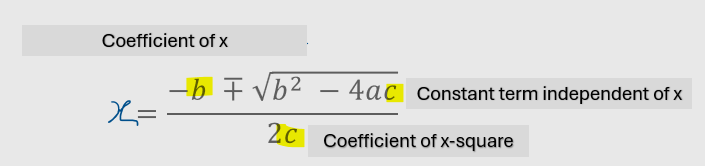
Note: Interpretation of the nature of roots is also important for quadratic equations.
If b^2 > 4ac, the function has two unique roots and it will cross the x-axis in two separate places
If b^2 = 4ac, the function has two equal roots and it will only cross the x-axis in one place
If b^2 < 4ac, the function has no real roots (only complex roots), it will not cross the x-axis at all and thus the function will always be above the x-axis.
Example: Find the roots of f(x) = x^2 − 5x + 6.
Solution (Factoring): Set f(x)=0. Therefore, x^2 − 5x + 6 = (x−2)(x−3)=0
So, either x = 2 or x=3.
Interpretation: Here, b^2 - 4ac = 25 - (4*1*6) = 25 - 24 = 1 ⇒ the function has two real roots. The parabola crosses the x-axis at x = 2 and x=3.
C. Cubic Functions
A cubic function is of the form: f(x) = ax^3+bx^2+cx+d, where a, b, c and d are constants and are called parameters that describe the shape of the function. These functions can have up to three real roots.
Example: Find the root of f(x) = x^3 −6x^2 + 11x − 6.
Solution (Factoring): In this case we use the Factoring & Trial method.
Try x=1, therefore, f(1) = 1 − 6 + 11 − 6 = 0. As the value of f(x) is zero for x = 1, it is a root for the given function.
We can also try factoring the cubic like: f(x) = (x−1) (x−2) (x−3). Thus, the roots are x=1, 2, 3.
4. Final Thoughts
Understanding the roots of functions is essential for solving equations, analyzing real-world problems, and interpreting graphs. Whether you’re calculating break-even points in business or solving mathematical problems, mastering this concept is vital.


Comments